If you are thinking about starting a crystal business, start with one question: is this market still worth entering today?
The answer is yes, but not in the easy way many new sellers imagine. People still buy crystals, and search demand has not disappeared. However, the market is more mature now. Buyers are more selective, competition is stronger, and a crystal business needs more than attractive products.
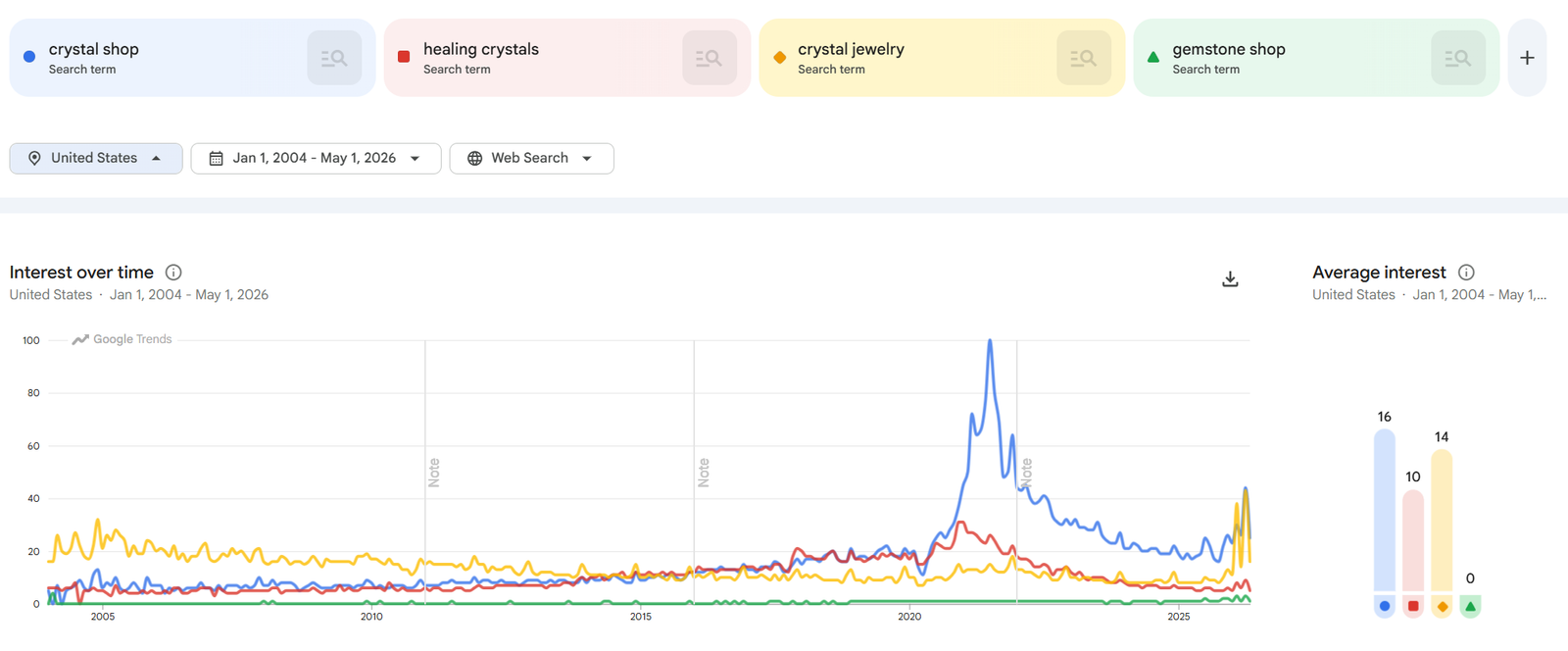
The Google Trends data shows that crystal-related searches still have activity, but demand is uneven. Terms like “crystal shop” and “crystal jewelry” show clearer buying intent, while “healing crystals” can be more trend-driven. This means the opportunity still exists, but sellers need to choose the right positioning instead of entering the market with random products.
If you are looking for a quick-profit niche, crystals may not be the best fit. But if you want to build a long-term business with clear products, reliable suppliers, honest descriptions, and healthy pricing, the crystal market is still worth studying.
This guide will help you understand the key decisions before starting: who buys crystals, which business model fits you, what products to test first, where to find wholesale suppliers, how to price for profit, and how to avoid the most common beginner mistakes.
8 Crystal Business Models to Start in 2026
Before starting a crystal business, the most important step is not buying inventory. It is choosing the right business model.
Different models require different inventory, budgets, customers, content skills, and sales rhythms. A live seller, a handmade crystal jewelry brand, a local market vendor, and an online crystal shop are not the same type of business.
You also need to separate business model from sales platform.
Online crystal shops, live selling, local markets, metaphysical shops, handmade jewelry brands, yoga and meditation retail, gift shops, boutiques, and home decor stores are business models. Etsy, Shopify, WooCommerce, TikTok Shop, Instagram, Facebook, and Square are sales platforms or tools.
Choose the business model first. Then choose the platform that fits it.
Business Model
Lean Startup Cost
Safer Starting Range
Cost Logic
Online Crystal Shop
$1,500–$5,000
$5,000–$15,000
Inventory may range from $800–$5,000; website or platform costs may run about $30–$150/month; additional costs include packaging, photography, samples, basic SEO, and content.
TikTok / Instagram / Facebook Live Selling
$1,000–$5,000
$3,000–$8,000
Live selling needs visually diverse inventory, lighting, product trays, packaging, live-streaming equipment, small gifts, and enough rotating stock.
Local Market / Craft Fair / Pop-up Vendor
$1,200–$6,000
$3,000–$10,000
Costs include inventory, booth fees, display racks, table covers, signage, POS tools, and transportation. Standard craft fair booths may range from $25–$400, while premium shows can reach $700–$2,000+.
Metaphysical / Witchcraft / Tarot Shop
Add-on: $2,000–$8,000; Full Store: $35,000–$90,000
Full Store: $50,000+
Adding crystals to an existing shop costs less. Opening a full physical store requires rent, deposit, buildout, shelving, POS, insurance, and deeper inventory. Similar spiritual retail startup models can reach around $54,000.
Handmade Crystal Jewelry & Craft Brand
$800–$5,000
$2,000–$8,000
Costs include beads, pendants, wire, tools, packaging, photography, and Etsy or social media operations. Inventory pressure is lower than large crystal pieces, but labor time can be high.
Reiki / Yoga / Meditation / Wellness Retail
$1,000–$5,000
$2,500–$10,000
If you already have a studio or customer base, crystals can be an add-on retail category. Main costs include small displays, chakra sets, palm stones, selenite, amethyst, clear quartz, and related curated products.
Gift Shop / Boutique / Home Decor Store
Add-on: $2,000–$12,000
$8,000–$30,000
Gift and home decor settings require stronger visual display, packaging, clear price tiers, and more mid-to-large display pieces, which raises inventory cost per item.
Etsy / Marketplace-first Crystal Shop
$800–$4,000
$2,000–$6,000
Platform setup costs are lower, but product photos, titles, reviews, platform fees, shipping costs, and product sameness can strongly affect profit.
1. Online Crystal Shop
An online crystal shop is best for sellers who want to build a long-term brand, grow through SEO and content, and create repeat purchases. This is not usually the fastest way to get orders, but it is better suited for building organic traffic, product categories, customer trust, and wholesale conversion over time.
This model works well for a complete crystal product structure, such as shopping by material, shape, or use case. Products may include bracelets, towers, spheres, palm stones, hearts, carvings, gift sets, and mixed crystal lots. It is especially suitable for sellers who want to build an independent website, sell wholesale crystals, target bulk crystal buyers, or serve resale customers.
The startup budget usually falls into two levels. A lean test may require around $1,500–$5,000, mainly for first inventory, a basic website, packaging, and product photos. A safer starting range is around $5,000–$15,000, which can support more SKUs, better photography, SEO content, basic ad testing, and restocking funds. Platform costs may look manageable, but the real cost usually comes from inventory, product images, content creation, and customer acquisition.
The biggest challenge for an online crystal shop is traffic. A new website has no organic rankings and no built-in marketplace search traffic. In the early stage, it is easy to have many products but very few visitors. New sellers should not launch with too many random products. Instead, they should build a clear structure around a few core materials and core shapes.
A lower-risk way to start is to choose 3–5 main materials, such as amethyst, rose quartz, clear quartz, fluorite, and black tourmaline, and 3–5 main shapes, such as bracelets, towers, spheres, palm stones, and hearts. Use a small test inventory to see which pages get clicks, which products receive inquiries, and which price ranges convert before placing larger restock orders.
2. TikTok, Instagram, and Facebook Live Selling
Live selling is best for sellers who are comfortable speaking on camera, can go live consistently, know how to show product details, and enjoy interacting with viewers. This model is not about listing products and waiting for search traffic. It relies on visual display, real-time explanation, limited-time offers, interaction, and trust.
Products that work well for live selling usually need strong visual appeal, clear price points, and easy presentation. Good examples include bracelets, tumbled stones, mini towers, small carvings, flashy labradorite, fluorite, mystery bundles, and new-arrival trays. These products are easier to show on camera and can quickly create buyer interest.
The startup budget usually ranges from $1,000–$5,000, mainly for visual inventory, lighting, phone stands, live trays, packaging materials, and shipping tools. A safer live-selling test budget is around $3,000–$8,000, because live sales need enough product variety and depth to keep viewers engaged.
The biggest risk is platform dependence. Account traffic, platform rules, live frequency, audience engagement, and account safety can all affect sales. Relying only on TikTok, Instagram, or Facebook is risky. If traffic drops or an account has problems, sales can be affected immediately.
A lower-risk way to start is to run 3–5 test live sessions first. Track viewer count, engagement, most-asked-about products, actual sales, average order value, and unsold inventory. Avoid buying too many large or niche pieces at the beginning. Start with small and mid-size products with strong visual appeal, then restock and expand categories after live sales become more consistent.
3. Local Markets, Craft Fairs, and Pop-up Vendors
Local markets, craft fairs, and pop-up events are good options for sellers who want to test offline customers with lower risk. The biggest advantage is direct feedback. You can see what customers pick up, what they ask about, what they think is too expensive, and what they actually buy.
Products for this model should be easy to carry, easy to explain, easy to display, and clearly priced. Good options include tumbles, bracelets, palm stones, hearts, small towers, mini carvings, and gift sets. In-person buyers usually do not want a long mineral explanation. They care more about appearance, price, feel, meaning, and whether the item works as a gift.
The startup budget usually ranges from $1,200–$6,000. Costs may include inventory, booth fees, table covers, display stands, price tags, packaging, POS tools, transportation, and backup stock. A safer test budget is around $3,000–$10,000. Booth fees vary widely depending on the event, location, size, and included services.
The main risk is inconsistent foot traffic. Even with good products, sales can be affected by low event traffic, bad weather, poor booth placement, or weak event promotion. Crystals are also heavy and fragile, so transportation, display setup, and packing efficiency matter.
A lower-risk way to start is to join 2–3 smaller local markets before committing to expensive large shows. Bring clear price tiers, such as $5, $10–$20, $25–$60, and $60+. Track which materials, shapes, and price ranges sell fastest, then restock based on real sales data.
4. Metaphysical, Witchcraft, and Tarot Shops
Metaphysical, witchcraft, and tarot shops are not just selling “pretty stones.” They are usually built around a complete spiritual retail experience. Crystals are often sold alongside tarot cards, candles, incense, altar tools, ritual items, books, herbs, and similar products.
This model is best for sellers who already serve spiritual, witchcraft, tarot, energy work, ritual, or metaphysical customers. These buyers usually care about crystal meaning, intention, chakra use, protection, cleansing, intuition, and ritual use, not just appearance.
Suitable products include black tourmaline, selenite, amethyst, clear quartz, rose quartz, obsidian, labradorite, moonstone, chakra sets, palm stones, towers, and altar-friendly pieces.
If you are adding a crystal section to an existing shop, the startup budget may begin around $2,000–$8,000. If you are opening a full physical store from scratch, the cost can be much higher, often reaching $35,000–$90,000+, because you need to consider rent, deposit, buildout, shelving, POS, insurance, staff, and deeper inventory.
The biggest risks are fixed costs and product knowledge. Customers may ask whether a crystal is real, what it is used for, what it means, whether it is dyed, or whether it fits a specific intention. If a shop only displays crystals as decoration without clear themes or basic knowledge, it is hard to build trust.
A lower-risk way to start is to create a small crystal corner instead of filling the entire shop with crystals. Display products by theme, such as protection, love, cleansing, intuition, meditation, and grounding. Test which themes customers buy from most often, then expand materials and shapes based on real sales.
5. Handmade Crystal Jewelry and Craft Brand
A handmade crystal jewelry and craft brand is not regular crystal retail. It is a design-driven product business. This model is best for sellers who can make handmade products, have a strong sense of style, and are willing to spend time on design, production, photography, and packaging.
Suitable products include crystal beads, pendants, cabochons, chip beads, wire-wrapped jewelry, bracelets, earrings, necklaces, zodiac jewelry, birthstone jewelry, and small handmade gifts. Customers are not only buying the crystal material. They are buying the design, styling, wearability, and gift value.
The startup budget usually ranges from $800–$5,000. For a small test, the main costs are beads, pendants, wire, findings, tools, packaging, and basic photography. A more complete test budget is around $2,000–$8,000, which can cover more materials, designs, packaging, and Etsy, Instagram, or local market testing. Etsy can be a good starting platform for this model, but listing fees, transaction fees, payment processing, ads, and shipping all need to be included in pricing.
The biggest risk is underestimating labor time. Many beginners only calculate material cost, but do not include design, making, photography, listing, packaging, and customer service time. As a result, the product may look profitable, but the real profit can be very thin.
A lower-risk way to start is to create 10–20 core designs instead of launching too many styles at once. Track which materials, colors, sizes, and price ranges sell best. For beads and pendants, pay close attention to size consistency, hole size, color batches, and restock ability.
6. Reiki, Yoga, Meditation, and Wellness Retail
Reiki, yoga, meditation, and wellness retail usually does not mean starting a crystal shop from scratch. It means adding crystal products to an existing service-based setting, such as a yoga studio, Reiki practice, meditation class, wellness shop, spa, healing space, or self-care brand.
The advantage of this model is that customers already have a use case. Crystals can be offered as add-on products for classes, meditation, space cleansing, chakra work, intention setting, or self-care rituals. These customers usually care more about how to use the product than about detailed mineral classification.
Suitable products include palm stones, chakra sets, selenite, clear quartz, amethyst, rose quartz, black tourmaline, meditation stones, intention kits, and small display pieces.
The startup budget usually ranges from $1,000–$5,000. If you already have a studio or customer base, crystals can work as an add-on retail category. Main costs include small inventory, display stands, packaging, and information cards. A safer budget is around $2,500–$10,000, especially if you want to build curated sets, workshop bundles, or a front-desk retail area.
The biggest risk is product mismatch. Yoga and meditation customers may not want a large selection of rare minerals. They usually need simple, easy-to-understand products that fit naturally into their practice. If the product mix is too random, it can weaken the professional feel of the space.
A lower-risk way to start is to create 5–10 curated crystal sets, such as a meditation set, chakra set, cleansing set, or calm and focus set. Test them in classes, workshops, front-desk displays, or member emails to see whether your existing customers are willing to buy.
7. Gift Shops, Boutiques, and Home Decor Stores
For gift shops, boutiques, and home decor stores, selling crystals is less about mineral knowledge and more about visual appeal, display, gifting, and atmosphere. Customers may not understand crystal meanings, but they can be attracted by color, shape, packaging, and giftability.
This model is best for existing gift shops, boutiques, home decor stores, lifestyle shops, and concept stores. Crystals can work as gifts, desk decor, seasonal displays, home accents, and high-perceived-value products.
Suitable products include hearts, mini towers, spheres, bowls, bookends, freeforms, statement pieces, boxed sets, zodiac products, birthstone-themed gifts, and polished display pieces.
If you are adding a crystal section to an existing store, the startup budget usually ranges from $2,000–$12,000. If you want to build a more complete home decor crystal assortment, the budget may reach $8,000–$30,000, because mid-to-large display pieces, gift packaging, seasonal inventory, and visual merchandising all increase costs.
The biggest risk is slow-moving inventory. Gift and home decor crystals often have stronger visual appeal, but they also come with higher item costs, heavier weight, greater breakage risk, and higher display requirements. If the product selection is not accurate, larger pieces can quickly tie up both cash and space.
A lower-risk way to start is to test 20–40 display-ready SKUs instead of buying too many large pieces at once. Products should have clear price tiers and simple labels, such as “gift under $25,” “desk decor,” “love and friendship gift,” or “statement piece.” Before major holidays, test seasonal themes such as Valentine’s Day, Mother’s Day, and holiday gifts.
8. Where Etsy, Shopify, WooCommerce, and TikTok Shop Fit
Etsy, Shopify, WooCommerce, TikTok Shop, Instagram Shop, and Facebook Shop are not business models by themselves. They are sales platforms or tools that support your business model.
Etsy is a better fit for handmade crystal jewelry, small giftable products, finished pieces, and items with search demand. Shopify and WooCommerce are better for long-term brands, independent websites, SEO, wholesale, and complete product categories. TikTok Shop, Instagram, and Facebook are better for content-driven sales, live selling, community selling, and impulse purchases.
New sellers should not begin by asking, “Which platform should I use?” A better question is: what type of crystal business am I building? Where do my customers buy? Are my products better suited for search, live selling, in-person shopping, or gift-style display?
Once the business model is clear, the platform choice becomes easier. An online crystal shop may use Shopify or WooCommerce. A handmade jewelry seller may test on Etsy first. A live seller may start with TikTok, Instagram, or Facebook. A local market vendor needs POS tools, display setup, and ways to encourage repeat purchases. Gift shops and boutiques need stable wholesale supply and display-ready product assortments.
Build Your First Crystal Inventory Mix
Your first inventory budget should depend on your business model, but the main rule is simple: buy enough to test the market, without putting too much pressure on cash flow.
For a small test, such as an Etsy shop, Instagram sales, a handmade jewelry brand, or crystal add-ons for a yoga or meditation studio, your first inventory can stay around $800–$1,500. This is enough for a basic test, but product variety will be limited.
For a more serious start, $1,500–$3,000 is a more practical range for most new sellers. It can cover several core materials, common shapes, and different price tiers without making the store look too empty or creating too much financial pressure.
For live selling, local markets, online crystal shops, or boutique add-on displays, $3,000–$6,000 is usually a safer range. These models need more product variety, deeper inventory, and clearer price levels to keep sales moving.
Beginners should avoid investing $10,000+ at the start unless they already have a physical store, a stable customer base, a proven live-selling account, an offline sales channel, or verified sales for a specific crystal category.
Your first inventory should be balanced. Do not buy only one material or one shape. A safer mix is to use small items to drive sales, mid-range products to increase order value, and a few visual pieces to improve display appeal.
Product Type
Suggested Share
Purpose
Small fast-moving products
35%
Improve conversion; good for beginners, gifts, and impulse purchases.
Core giftable products
30%
Suitable for most sales channels with stable price points.
Visual display products
20%
Improve product pages, live sales, and booth appeal.
Channel-specific products
10%
Add special products based on your business model.
Test products
5%
Test niche materials, unusual shapes, or higher-ticket items.
Choose Products by Price Tier
Your first inventory should have clear price tiers. If you only sell low-priced items, profit will be thin. If you only sell high-priced pieces, sales may be slow. A better approach is to build several price levels so different customers can make a purchase.
Retail Price Tier
Product Role
Suitable Products
Under $10
Impulse buys
tumbles, mini chips, small carvings
$10–$25
Core entry-level products
bracelets, palm stones, hearts
$25–$60
Giftable and mid-range products
small towers, spheres, sets, better carvings
$60–$150
Display products
medium towers, larger spheres, freeforms
$150+
High-ticket or collector pieces
large statement pieces, rare specimens
Beginners should not put too much of their first inventory budget into $150+ products. High-ticket pieces can improve the look and perceived value of a shop, but they usually move more slowly, require better photography, and carry higher shipping and breakage risk.
In the early stage, focus mainly on products in the $10–$60 range. This range is easier for testing real demand, especially for gifts, entry-level buyers, live selling, local markets, and online product pages.
Control Weight and Shipping Risk
Crystals are heavy and fragile. Many beginners only look at the wholesale cost, but do not fully calculate shipping, packaging, and breakage risk. Your first inventory should have a controlled weight structure.
A practical starting mix is:
70%–80% small and mid-size products
10%–20% mid-to-large display products
5%–10% high-risk large pieces or test products
Weight Range
Product Examples
Starting Advice
Under 100g
bracelets, tumbles, mini carvings, pendants
Good for testing and can be purchased in larger quantities.
100–500g
palm stones, hearts, small towers, small spheres
A strong core category for first inventory.
500g–2kg
medium towers, spheres, freeforms
Use in smaller quantities to improve display appeal.
2kg+
large statement pieces, geodes, large carvings
Beginners should buy carefully and in limited quantities.
Large crystal pieces are not wrong to buy, but they should not take up too much of your first inventory budget. They can improve visual appeal and raise average order value, but they are usually not the best core inventory for a new seller.
Choose Products with Strong Visual Appeal
Crystal sales depend heavily on visuals. Whether you sell through an independent website, Etsy, Instagram, TikTok Live, or local markets, customers first notice color, shape, shine, clarity, texture, and overall appearance.
Your first inventory should include some products that are easy to show visually, such as:
Labradorite for its flash
Fluorite for color bands and translucency
Amethyst for strong color recognition
Rose quartz for gifts and love-themed products
Clear quartz for beginners, meditation, and cross-selling
Tiger eye for its sheen and natural pattern
Carnelian for bold color and social media appeal
Black tourmaline / obsidian for protection-themed products
However, do not buy products only because they look good on camera. Visual appeal is important, but you still need to consider price, shipping risk, customer understanding, and restock ability.
Match Inventory to Your Sales Channel
Your first inventory should follow general buying principles, but it still needs to match your sales channel.
An online crystal shop needs a clear product structure. It is better suited for material and shape collections, such as amethyst bracelets, amethyst towers, rose quartz hearts, and clear quartz spheres.
Live selling needs more visual impact and products that can sell quickly in the moment. A first inventory mix can include more bracelets, tumbles, mini towers, flashy pieces, small carvings, and mystery bundles.
Local markets work best with products that are easy to pick up, easy to ask about, and clearly priced. Tumbles, bracelets, hearts, palm stones, and small towers are easier to sell in person.
A handmade crystal jewelry brand should focus on beads, pendants, cabochons, chip beads, and charms. The key is not buying many finished products, but sourcing stable materials that can be used repeatedly in designs.
Reiki, yoga, meditation, and wellness retail works better with curated sets, such as chakra sets, meditation sets, cleansing sets, and calm and focus sets. The product mix should not be too random. It needs to fit naturally into classes, healing sessions, and space-cleansing use cases.
Gift shops, boutiques, and home decor stores are better suited for giftable and display-ready products, such as hearts, mini towers, spheres, bookends, bowls, boxed sets, and statement pieces.
Products to Avoid Buying Too Early
Beginners should avoid several types of products in their first inventory.
The first is oversized statement pieces. They may look attractive, but they tie up more cash, cost more to ship, carry higher breakage risk, and usually move more slowly.
The second is very niche materials. If customers do not recognize the stone, you will need more explanation and customer education. Unless you already have the right audience, avoid buying too much of these products early.
The third is products with large batch variation. If the product photos and the actual item received look too different, it can easily lead to customer complaints or returns.
The fourth is products with unclear treatment. Dyed, synthetic, coated, heat-treated, or composite materials are not always a problem, but they must be clearly explained. If not, they can quickly damage customer trust.
The fifth is low-priced small items with very thin profit. Low-priced products can help drive sales, but after packaging, platform fees, payment fees, and shipping are included, the profit may be too low. In that case, sell them as bundles or use them to increase average order value.
Use the First Order as a Test
The most important goal of your first order is not to make your shop look full. It is to generate useful data. Track:
which materials get the most clicks;
which shapes receive the most questions;
which price ranges sell fastest;
which products photograph best;
which products are hardest to pack and ship;
which products have the best profit;
which products do not sell within 30–60 days;
which products are worth restocking.
A healthy testing goal can look like this:
Timeframe
Goal
First 30 days
Identify the products that get the most clicks, questions, saves, or attention.
First 60 days
Sell 40%–60% of the test inventory, or clearly identify slow-moving products.
First 90 days
Restock only proven products and reduce weaker categories.
The Main Rule: Buy for Testing, Not for Guessing
The core rule for your first inventory is simple: use a small order to test real demand, not a large order to gamble on assumptions.
A better first inventory is not the one with the most product types. It is the one with a clear structure:
low-priced products to drive sales;
mid-range products to support profit;
visual products to increase appeal;
a small number of test products to explore opportunities;
restockable products to support future growth;
clear fit with your sales channel;
clear cost and pricing logic.
What beginners should avoid is not “buying too little.” The real risk is buying products that are too scattered, too heavy, too expensive, too hard to explain, or too hard to restock.
If your first order helps you understand your customers, sales channel, and product direction, it has already done its most important job.
Find Reliable Wholesale Crystal Suppliers
What to Look for in a Wholesale Crystal Supplier
What to Check
Why It Matters
How Beginners Should Judge It
Clear Material Names
Crystals should not be sold only by color or marketing names. Unclear material names can affect product listings, sales, and customer trust.
The supplier should clearly label specific materials such as amethyst, rose quartz, clear quartz, fluorite, and obsidian.
Natural / Treated / Dyed / Synthetic Disclosure
Dyed, treated, synthetic, or composite materials can still be sold, but they must be clearly disclosed.
Check whether the supplier explains if products are natural, dyed, treated, synthetic, or composite.
Size, Weight, and Selling Unit
Natural crystals vary. If size, weight, or selling unit is unclear, buyers may receive products that do not match expectations.
Confirm whether products are sold by piece, strand, kilogram, or lot, and check the size or weight range.
Low MOQ
A high MOQ can force beginners to spend too much budget on too few products, increasing inventory risk.
Beginners should choose suppliers with low MOQ or small-batch testing options.
Mixed Orders
The first order should test different materials, shapes, and price points, not stock too much of one product.
Prioritize suppliers that support mixed orders across materials, shapes, and sizes.
Product Photos and Batch Accuracy
Crystal color, texture, cracks, clarity, and patterns can vary by batch. Over-edited photos increase after-sales risk.
Check whether photos are close to the actual batch and whether natural color and batch variation are explained.
Packaging for Fragile Products
Crystals are heavy and fragile. Poor packaging can directly increase breakage costs.
Pay attention to whether towers, points, spheres, carvings, and large pieces have reinforced packaging.
Restock Ability
If your first order sells well but cannot be restocked, it is hard to scale the business.
Choose suppliers that can provide common materials and shapes consistently over time.
Review processing time, shipping terms, damage claim rules, and return or replacement policies before ordering.
Compare Different Types of Crystal Suppliers
Supplier Type
Best For
Advantages
Risks
Specialized Wholesale Crystal Websites
Beginners, small online shops, live sellers, Etsy sellers, local market vendors, and gift shops
Focused product selection, clear categories, and easier buying by material, shape, and price tier. Better for small-batch testing and mixed orders.
You still need to compare MOQ, shipping cost, product descriptions, packaging, and restock ability.
Direct Factory / Source-Market Suppliers
Sellers with proven sales, larger restock needs, or custom product requirements
Better bulk pricing, stronger production capacity, and more stable long-term supply.
MOQ may be higher, and communication, quality control, international shipping, and packaging requirements are more demanding.
Gem and Mineral Shows
Physical stores, collector-focused sellers, and experienced buyers
You can inspect products in person and judge color, weight, cracks, and quality directly.
Requires time, travel, buying experience, and stronger cash flow. It is also easy to overbuy on-site.
Online Wholesale Marketplaces
Sellers who want to compare prices, find styles, or test new products
Large selection, wide price range, and many product styles.
Higher risk in material labeling, photo accuracy, quality control, packaging, and after-sales support.
Local Importers / Distributors
Offline stores, local sellers, and buyers who need faster restocking
Faster delivery, easier communication, and relatively easier returns or exchanges.
Unit prices are usually higher, and product selection may be limited.
Mixed-Lot Suppliers
Beginners with small budgets and low-barrier testing needs
You can buy many product types at once, which makes the first order feel easier.
Batch consistency, quality, and material information may be unclear, and restocking the same products can be difficult.
For beginners starting a crystal business, the safest starting point is usually a specialized wholesale crystal website, especially one that supports low MOQ, mixed orders, clear product descriptions, and secure packaging. This allows you to test different products with a smaller budget, instead of putting too much money into high-MOQ, large-volume, or unclear supply sources too early.
This is where CrystalWholesale.com can naturally fit as a sourcing option. It is suitable for new sellers building their first test inventory, especially online crystal shops, live sellers, Etsy sellers, local market vendors, gift shops, handmade jewelry brands, and wellness retailers that need small-batch mixed orders.
For sellers who need additional support, we can also provide small-batch product customization, custom cards, and packaging solutions.
Price Your Crystals for Profit
Crystal pricing should not be based only on wholesale cost, and you should not simply apply “cost × 2” or “cost × 3.” These markups can be useful references, but real pricing should consider three things: minimum cost, market acceptance, and profit structure.
In simple terms, first decide the lowest price at which the product is still worth selling. Then adjust the final price based on appearance, rarity, use case, sales channel, and customer acceptance.
Calculate the Minimum Acceptable Price
Before listing any product, calculate a bottom-line price. This is not the price you want to sell at. It is the price below which the product is no longer worth selling.
Your minimum price should cover:
Cost Item
What It Includes
Product Cost
Wholesale product cost
Inbound Shipping
Shipping cost from the supplier to you, divided by item
Packaging
Boxes, bubble wrap, labels, gift packaging
Platform / Payment Fees
Etsy, website, PayPal, credit card fees
Labor
Photography, listing, packing, customer service, shipping time
For example, if a bracelet costs $3 wholesale, but the true cost becomes $6.50 after shipping, packaging, fees, labor, and loss allowance, and you want a 40% profit margin:
$6.50 ÷ (1 – 0.40) = $10.83
That bracelet should sell for at least $11–$12 to make sense.
Also remember that markup and profit margin are not the same. If a product costs $10 and sells for $20, that is a 100% markup, but only a 50% profit margin. Many beginners confuse the two and overestimate their real profit.
Adjust Pricing by Product Value
After calculating the minimum price, the final price is not fixed. Crystals are not fully standardized products, so the perceived value of each piece matters.
Factor
How It Affects Pricing
Material
Common materials have more transparent pricing; rare or popular materials may allow higher margins.
Size and Weight
Larger and heavier pieces cost more to ship and package, so pricing must cover that risk.
Color and Clarity
Better color, clarity, texture, and pattern can support higher pricing.
Shape and Workmanship
Spheres, towers, carvings, and freeforms have different cutting costs and material loss.
Visual Appeal
Products that photograph well, sell well on live video, or display well as gifts can have higher perceived value.
Use Case
Gifts, meditation tools, home decor, jewelry materials, and collector pieces follow different pricing logic.
Restock Difficulty
Products that are hard to restock or vary greatly by batch should not be priced like standard fast-moving items.
For example, rose quartz tumbles, polished hearts, spheres, towers, and carvings should not be priced only by weight. Shape, polish, visual appeal, and gift value all affect what customers are willing to pay.
In practice:
small items depend more on cost control and bundle sales;
mid-range products depend more on appearance and gift value;
large pieces depend on visual impact, weight, packaging risk, and cash flow;
handmade products must include labor and design value.
Plan Profit by Price Tier
Do not put all products in the same price range. A healthy crystal shop usually needs low-priced entry products, mid-range profit products, and a few higher-ticket display pieces.
Price Tier
Role
Suitable Products
Pricing Focus
Under $10
Traffic and impulse buys
tumbles, mini carvings, small chips
Use bundles to avoid thin single-item profit.
$10–$25
Core entry-level products
bracelets, palm stones, hearts
Control cost and keep stable profit.
$25–$60
Giftable and profit-core products
small towers, spheres, gift sets, carvings
Improve packaging, photos, and use-case value.
$60–$150
Mid-to-high-ticket products
medium towers, larger spheres, freeforms
Cover packaging, breakage, and slower turnover risk.
$150+
Display and collector pieces
large statement pieces, rare specimens
Keep limited stock and avoid tying up too much cash.
For beginners, the safer structure is to place most profit focus in the $10–$60 range.
Low-priced products can help drive orders, but they often work better as bundles. High-ticket products can improve the look of your shop, but they should not take up too much early inventory budget.
Adjust Pricing by Sales Channel
The same product may need different pricing on different channels because the cost structure is different.
Sales Channel
Pricing Focus
Online Crystal Shop
Cover website costs, payment fees, content, photography, and customer acquisition.
Etsy / Marketplace
Pay close attention to platform fees, ads, free-shipping pressure, and low-price product profit.
Live Selling
Include live-streaming time, discounts, gifts, unsold inventory, and packing efficiency.
Local Market / Pop-up
Include booth fees, transportation, display setup, and same-day labor.
Handmade Jewelry
Include design, making time, photography, packaging, and customer service.
Gift / Boutique / Home Decor
Use packaging, display, and gifting context to increase perceived value.
For example, a $15 palm stone sold at a local market may not be as profitable as it looks if booth fees and transportation are high. A low-priced Etsy item can also lose profit quickly after platform fees and shipping.
So do not only ask, “What are other sellers charging?” Ask this instead:
After I sell one item through this channel, how much profit do I actually keep?
Step 2: Set a target profit margin Most regular products should keep at least 35%–50% gross margin. Low-priced products can use bundles to raise order value. Handmade products must include labor time.
Step 3: Check market pricing Compare products with the same material, size, shape, and quality level.
Step 4: Place the product into a price tier Use tiers such as under $10, $10–$25, $25–$60, $60–$150, and $150+.
Step 5: Test for 30–60 days Track clicks, questions, sales, and profit. Then decide whether to adjust the price or restock.
This process is more reliable than using a simple markup alone. Markups like 2x, 2.5x, or 3x can be a starting point, but final pricing should always return to true cost, channel expenses, and customer acceptance.
Set Up the Business Basics
Handle the Legal and Tax Basics
When selling crystals in the United States, registration, permits, and sales tax requirements can vary by state, city, business structure, and sales channel. New sellers do not need to master every legal detail at the beginning, but they should know what to check before taking payments.
Setup Item
What to Check
Business name
Whether the shop name is available and fits your long-term brand direction.
Business structure
Whether you will operate as a sole proprietor, LLC, or another structure.
EIN / Tax ID
Whether you need an EIN, state tax ID, or other tax identification number.
Seller’s permit / Sales tax permit
Whether you need a sales tax permit and whether you need to collect and report sales tax.
Resale certificate
Whether you can use it for wholesale or tax-exempt purchasing.
Local permits
Whether local permits are required for markets, pop-ups, or a physical store.
Business bank account
Whether you need a separate account to manage income and expenses.
Insurance
Whether markets, physical stores, or events require business insurance.
If you sell through marketplaces such as Etsy, Amazon, or eBay, the platform may collect sales tax in many states. But if you also sell through an independent website, social media, local markets, or wholesale channels, you should not assume that the platform handles everything for you. Multi-channel sellers should check the requirements in their own location and in the places where they sell.
The goal is not to become a tax expert before starting. The goal is to make sure you understand whether you need business registration, permits, tax accounts, and sales tax settings before you begin taking orders.
Set Up Inventory, Payments, and Records
Crystal inventory is more complex than standard products. Many pieces have natural variation. Even within the same batch, towers, spheres, hearts, bracelets, or carvings may differ in color, pattern, size, and weight. If you sell across your website, live sales, Etsy, and local markets, inventory can become messy very quickly.
At minimum, beginners should track:
Record
Why It Matters
Product name / SKU
Helps prevent order, inventory, and restocking confusion.
Material
Shows which materials sell best, such as amethyst, rose quartz, or clear quartz.
Shape
Helps compare the performance of bracelets, towers, spheres, hearts, and other shapes.
Supplier
Makes restocking, quality tracking, and after-sales issues easier.
Cost
Helps calculate real profit.
Selling price
Shows whether pricing is healthy.
Quantity
Helps prevent overselling, missed items, and duplicate sales.
Sales channel
Compares real performance across Etsy, live selling, your website, and local markets.
Damage / return notes
Tracks breakage rate and supplier stability.
At the beginning, a spreadsheet is enough. As orders grow, you can consider a POS system, inventory plugin, Etsy / Shopify / WooCommerce inventory tools, or multi-channel inventory software.
Payment methods should also be clear before you start selling. Online sales may need PayPal, credit card payments, Shop Pay, Stripe, or platform payment tools. Local markets need POS or mobile payment tools. Live selling needs a clear process for claims, invoices, payment deadlines, and shipping.
A simple but clear record system is more useful than a complicated tool. What beginners should avoid is selling many orders without knowing which products are profitable, which products should be restocked, and which products are only taking up inventory.
Prepare Clear Store Policies and Product Descriptions
Crystals naturally vary in color, pattern, cracks, inclusions, size, and batch appearance. The clearer your store policies and product descriptions are, the fewer after-sales disputes you will have.
At minimum, prepare these basic policies:
Policy
What It Should Explain
Shipping policy
Processing time, shipping methods, tracking, and international shipping details.
Return policy
Which situations allow returns or exchanges, and which products are not eligible.
Damage policy
How shipping damage is handled and what photos or proof are required.
Processing time
How long it takes to ship after an order is placed.
Product variation notice
Natural crystals may vary in color, size, and pattern.
Exact-piece or sample-photo rule
Whether the photo shows the exact item or a sample from the same batch.
Treatment disclosure
Whether the product is natural, dyed, treated, synthetic, or composite.
Product descriptions should also be standardized. Each product page should clearly include:
material;
shape;
size range;
weight, if needed;
sold by piece, strand, lot, or kg;
color variation;
treatment status;
possible cracks, inclusions, or natural marks;
care or display notes, if relevant.
This is not about making every product page unnecessarily long. It is about setting the right expectations before the customer buys. Crystals are not fully standardized products, and clear information about natural variation, treatment, and size range can increase trust.
Common Mistakes New Crystal Sellers Make
Buying Too Much Inventory Too Early One of the most common beginner mistakes is buying too much inventory at the start, especially large pieces, niche materials, or too many units of one style. Your first order should be used for testing, not filling a warehouse.
Choosing Products Only Based on Personal Taste The crystals you personally like are not always the products customers want to buy. Product selection should be based on your target customer, sales channel, price range, and restock ability.
Ignoring Shipping Weight and Breakage Risk Crystals are heavy and fragile. Towers, spheres, geodes, and large carvings may look like high-value products, but they also come with higher packaging, shipping, and breakage costs.
Pricing Only by Wholesale Cost Using only “wholesale cost × 2” or “wholesale cost × 3” can easily underestimate real costs. Pricing must include shipping, packaging, platform fees, payment fees, labor, loss allowance, and marketing costs.
Selling Unclear or Mislabeled Crystals Failing to clearly label whether a product is natural, dyed, treated, synthetic, or composite can seriously damage customer trust. Treated crystals can still be sold, but the treatment must be clearly disclosed.
Starting Without a Clear Customer Type Beginner crystal buyers, gift buyers, collectors, jewelry makers, live-sale customers, and wellness customers all have different needs. If you try to sell to everyone, your product selection usually becomes too unfocused.
Relying on Only One Sales Channel Depending only on TikTok, Instagram, Etsy, or local markets is risky. Platform traffic, account status, rule changes, and event foot traffic can all affect sales.
Using Weak Product Photos Crystal sales depend heavily on visuals. If your photos do not clearly show color, size, texture, flash, clarity, and natural marks, customers will have a harder time deciding whether to buy.
Not Tracking Inventory and Profit by Product Type Total sales alone are not enough. Sellers need to know which materials, shapes, price tiers, and channels are truly profitable, and which products only sell fast with thin margins.
Buying from the Cheapest Supplier Only The lowest price is not always the lowest risk. Unclear materials, unstable batches, poor packaging, and poor restock ability can all become higher costs later.
Ignoring Restock Ability If your first products sell well but cannot be restocked, it is hard to scale the business. Beginners should prioritize products that can be supplied consistently over time.
Selling Too Many Random Products A product mix that is too scattered makes the shop feel unfocused. Your first inventory should be built around clear materials, shapes, customers, and channels, not just whatever looks cheap.
Underestimating Labor Time Photography, listing, live selling, packing, shipping, customer service, and after-sales support all take time. Handmade crystal jewelry sellers especially need to include design and making time in their pricing.
No Clear Shipping, Return, or Damage Policy Crystals have natural variation and can be damaged during shipping. Without clear policies, after-sales disputes become more likely.
Not Testing Before Scaling Beginners should not try to build a large, complete product catalog too early. A safer approach is to test small batches for 30–90 days, then restock, remove weak products, and expand based on real sales data.
First Crystal Business Starter Checklist
Checklist Item
Success Standard / Goal
Choose one main business model
You have clearly chosen one main model, such as an online shop, live selling, local market, handmade jewelry, wellness retail, or gift shop. Do not launch too many channels at once.
Define your target customer
You can clearly explain who you are selling to: beginner crystal buyers, gift buyers, healing or spiritual buyers, handmade jewelry buyers, collectors, resale buyers, or another specific group.
Research 10–20 competitors
You have recorded their product types, price ranges, photo style, best-selling items, product descriptions, reviews, and shipping policies.
Decide your first product direction
You have chosen 3–5 core materials and 3–5 core shapes instead of buying random products.
Control your first inventory structure
Small and mid-size products make up 70%–80% of your first inventory. Large, high-risk, or niche products stay within 10%–20%.
Build clear price tiers
Your products cover at least three price ranges, such as under $10, $10–$25, and $25–$60, instead of being concentrated only in low or high prices.
Choose reliable suppliers
Your supplier supports low MOQ and mixed orders, and can clearly explain material, size, selling unit, treatment, packaging, and restock ability.
Complete basic pricing calculations
You have calculated the true cost of each product: wholesale cost + inbound shipping + packaging + platform/payment fees + labor + loss allowance.
Confirm the minimum selling price
Each product has a minimum acceptable price. Below that price, you either do not sell it, do not discount it, or only sell it as part of a bundle.
Prepare a product information template
Each product can clearly include material, shape, size, weight, treatment, natural variation, and whether it is sold by piece, strand, lot, or kg.
Prepare basic store policies
You have a shipping policy, return policy, damage policy, processing time, and product variation notice.
Build an inventory tracking sheet
At minimum, you track SKU, material, shape, cost, selling price, quantity, supplier, sales channel, and profit.
Start with one main sales channel
You have chosen one main channel to test first, such as Etsy, an independent website, TikTok Live, a local market, or Instagram. Do not spread across every channel at once.
Set a 30–90 day test period
In the first 30 days, track clicks and inquiries. By 60 days, review sales and inventory movement. By 90 days, decide what to restock, reprice, or remove.
Track key data
You are tracking best-selling materials, best-selling shapes, average order value, profit by product type, and slow-moving products.
Restock only proven products
Only products that meet three conditions — real demand, healthy profit, and restock ability — should enter the next restock cycle.
Identify slow-moving products
If a product gets no clicks, questions, or sales within 60–90 days, consider discounting it, bundling it, changing channels, or stopping future restocks.
Keep a cash buffer
You have not spent your entire budget on inventory. You still have cash for packaging, restocking, shipping, breakage, and promotion tests.
Simple Validation Standard
If you have completed the five checks below, you are ready to start your first test round.
Core Check
Success Standard
Clear business model
You know which main model you will use to sell crystals.
Clear customer
You know who you are selling to and why they buy.
Clear inventory mix
Your first inventory is not random. It has a structure by material, shape, price tier, and weight.
Clear cost
You know the minimum selling price and estimated profit for each product.
Clear channel
You have chosen one main sales channel and are ready to test real sales data for 30–90 days.
FAQ
Do I need a business license to sell crystals?
In the United States, this depends on your state, city, sales channel, and business setup. Crystals are physical products, so many states may require a seller’s permit or sales tax permit. If you sell at local markets, open a physical store, or use a DBA name, you may also need a city or county business license. Sellers should check the SBA license and permit guide, their state tax department website, and their local city or county business license office.
Do I need a resale certificate to buy wholesale crystals?
If you buy wholesale crystals in the United States for resale, a resale certificate is usually useful, but rules vary by state. Many states require you to register for a seller’s permit or sales tax permit before using a resale certificate legally. It is generally used for crystals, jewelry materials, beads, pendants, or gift sets that will be resold. It should not be used for personal tools, display supplies, or crystals kept for personal use. Check your state Department of Revenue, Taxation, or Comptroller website for exact requirements.
Can I sell crystals from home?
Yes. Many beginners start from home through Etsy, Instagram, TikTok Live, an independent website, or handmade crystal jewelry. You still need to plan inventory storage, a photo area, packing space, order records, and shipping workflow. Crystals are heavy and fragile, so storage and packing can take more space than ordinary small products as inventory grows.
Should I sell crystals individually or in bundles?
Both can work. Individual sales are better for towers, spheres, carvings, bracelets, statement pieces, and products with clear standalone value. Bundles are better for low-priced items, tumbles, starter sets, chakra sets, gift sets, and live selling. For beginners, low-priced items often work better in bundles because they can increase average order value and profit.
Should I use exact-piece photos or sample photos?
Use exact-piece photos for higher-priced products, pieces with strong patterns, or crystals with large natural variation. Customers should see the exact item they will receive. For batch products such as bracelets, tumbles, beads, and small carvings, sample photos can work, but the product page should clearly explain that each piece may vary in color, size, and pattern.
How should I describe natural variation in crystals?
You can state clearly that natural crystals may vary in color, pattern, cracks, inclusions, clarity, and size. These features are often part of natural materials and are not always defects. Product descriptions should include approximate size, approximate weight, whether the item is sold by piece, strand, or lot, and whether the photo is a sample photo or an exact-piece photo.
How do I handle damaged crystals during shipping?
Pack crystals based on shape and weight, especially towers, points, spheres, carvings, and large pieces. Your store policy should explain how damage claims are handled, how many days customers have to contact you, and what photos are required, such as outer packaging photos, product photos, and order information. This helps reduce disputes and makes it easier to track issues with carriers or suppliers.
How long should I test before restocking?
A first test round should usually run for 30–90 days. In the first 30 days, track clicks, questions, saves, and engagement. By 60 days, review sales, inventory movement, and profit. By 90 days, decide which products to restock, reprice, or stop buying. Do not restock based on feeling. Restock only products that meet three conditions: real demand, healthy profit, and reliable restock ability.