
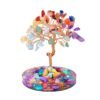
3 Sizes of Purple Amethyst Double-Terminated Crystal Point Wholesale
$21.60 ~ $27.00
Meaning, Birthstone, Healing Properties, Mineralogy & History
Amethyst is the purple variety of quartz and is composed of silicon dioxide. Its most recognizable feature is its natural range of purple tones, which can vary from pale lavender and lilac to deep violet and reddish purple. Because of this rich variation in color, amethyst has long been one of the most popular and easily recognized quartz varieties.
Amethyst’s purple color is not caused by a single factor. It is generally associated with trace amounts of iron within the crystal structure, together with long-term natural irradiation. This formation process is why amethyst often shows natural variations in tone, color zoning, and areas of uneven saturation.
The name amethyst comes from the ancient Greek word amethystos, a term associated with “not being drunk.” The ancient Greeks believed that amethyst could help the wearer remain clear-headed, self-controlled, and sober, which is why it is often referred to as the Stone of Sobriety.
As this traditional belief continued over time, the symbolic meaning of amethyst gradually expanded. Today, amethyst is commonly associated with clarity, calmness, inner balance, energy cleansing, protection, and higher awareness. For this reason, amethyst is widely regarded as the most iconic symbolic crystal.

Amethyst carries a calm, steady energy that helps settle mental noise. When emotions run high and thoughts start racing, it slows the inner rush, softens impulsive reactions, and brings the mind back into focus. Instead of feeding emotional chaos, amethyst creates space for clarity, patience, and steadier thinking.
It is especially helpful during stressful or emotionally messy periods, when it feels hard to sort out what you really think or feel. Amethyst supports mindfulness, emotional balance, and clearer decision-making by helping the mind quiet down enough for the right answer to come through.
Amethyst also has a long connection with self-control and sobriety. It helps bring awareness to unhealthy habits, addictive patterns, and self-defeating cycles, reminding you to pause, reflect, and return to a more balanced state. Wearing amethyst jewelry keeps that reminder close throughout the day.
Amethyst holds a gentle but elevated energy that naturally turns attention inward. It draws the mind toward stillness, insight, and a more awakened state of consciousness, which is why it is one of the strongest crystals for spiritual growth, meditation, and higher awareness.
In meditation, amethyst helps clear inner distractions and quiet mental chatter. Its strength is not in intensity, but in clarity. It helps create a calmer inner space, making it easier to listen inwardly and notice subtle guidance.
Amethyst also works as a stone for energy cleansing and energetic protection. It clears lingering heaviness, refreshes the energy of a space, and restores a sense of spiritual steadiness. Amethyst points and pyramids work especially well in meditation corners, bedrooms, and other quiet spaces where calm and clarity are needed.
Amethyst supports rest, relaxation, and physical ease. Its calming effect on the mind often helps the body unwind as well, which is why it is often used in bedtime rituals and quiet evening spaces.
It is commonly placed near the bed to ease tension, settle the atmosphere, and support more restful sleep. Some crystal practitioners also connect amethyst with relief from head tension and support for the body’s natural balance, but its physical healing role is usually secondary to its calming and spiritual qualities.
| Property | Detail |
|---|---|
| Mineral Species | Quartz |
| Luster | Vitreous |
| Crystal System | Trigonal |
| Transparency | Transparent to translucent |
| Common Crystal Habit | Hexagonal prism faces with rhombohedral terminations |
| Cleavage | None |
| Refractive Index | 1.544–1.553 |
| Fracture | Conchoidal |
| Birefringence | 0.009 |
| Specific Gravity | 2.66 |
Amethyst is not a separate mineral species in its own right. It is the purple variety of quartz. Its chemical composition is still silicon dioxide (SiO₂), so it does not belong to a different mineral group from clear quartz, smoky quartz, or citrine. They are all color varieties within the quartz family, with their differences coming from color-causing conditions rather than from a different mineral identity.

Because of that, amethyst still retains the core characteristics of quartz in its hardness, optical behavior, and physical properties. These include a vitreous luster, no cleavage, a typical conchoidal fracture, and good everyday durability.
From a crystallographic standpoint, quartz belongs to the trigonal crystal system. Its familiar outward shape is controlled by a combination of hexagonal prism faces and rhombohedral terminations, which is why it so often appears as the classic six-sided crystal form that narrows toward the tip. It is important to separate appearance from crystal classification here: a hexagonal outline describes the crystal’s external geometry, but that does not make quartz part of the hexagonal crystal system. Stable low quartz is classified as trigonal.
Amethyst does not get its purple color from a separate “purple mineral ingredient.” Its color comes from color centers formed when Fe³⁺ replaces Si in the quartz structure and is then modified by irradiation. The color of amethyst is usually not perfectly even. Shifts in tone, color zoning, banding, growth phantoms, and even transitions from purple to colorless are all very typical features of natural amethyst.

Green Amethyst is a very common product name in the market, but from a stricter gemological standpoint, prasiolite or green quartz is the more accurate term. Much of the material in circulation was created by heating amethyst until it turned green, so it cannot strictly be described as natural green amethyst.
Pink Amethyst is closer to a modern collector and decorative trade name than to a standard independent gemological category or a formal mineral classification. It represents a color grouping within amethyst, with tones ranging from pale pink and pinkish purple to soft lilac and even peachy hues.
Chevron Amethyst is an amethyst material marked by bands of white quartz. The purple areas come from the color-causing mechanism of amethyst, while the white areas usually represent milky quartz. That white appearance does not come from a separate white mineral ingredient. It is mainly caused by the scattering of light from large numbers of tiny fluid inclusions inside the crystal.

Chevron Amethyst usually shows clear V-shaped, arrow-like, or layered banded patterns, which is why it is also commonly sold as Banded Amethyst. In the market, Dream Amethyst is often used as another name for Chevron Amethyst.
Geologically, amethyst does not form in just one type of setting. Its most important natural environments fall into three main categories: cavities and geodes in volcanic rocks, hydrothermal veins, and certain cavities related to sedimentary rocks or volcanic-sedimentary deposits.
Amethyst does not form as a single purple stone growing directly inside solid rock. It forms in pre-existing geological spaces where silica-rich fluids gradually deposit and crystallize over time.
As of 2026, the world’s main amethyst sources are Brazil, Uruguay, Zambia, and Bolivia. Brazil and Uruguay are the most important and most classic geode-producing sources in the mainstream market. Veracruz, Mexico is better known as a world-class locality for fine collector crystals, with typical material showing high transparency, attractive crystal habits, frequent double-terminated or scepter forms, strong color zoning, and excellent collectibility. Zambia is one of the key sources for deeply saturated, darker-colored material.
Bolivia is distinctive because the Anahí Mine produces natural ametrine, in which amethyst and citrine occur together in the same crystal. A single crystal from this deposit may be cut as amethyst, citrine, or a bi-colored purple-and-yellow gemstone.
In hydrothermal vein deposits, amethyst may also occur with calcite, galena, barite, sphalerite, chalcopyrite, and quartz. In Brazil-Uruguay-style volcanic geodes, amethyst commonly occurs with chalcedony, colorless quartz, calcite, barite, gypsum/anhydrite, and goethite, often showing a clear sequence of staged mineral filling.
In ancient Greece, around 1200-323 BCE, amethyst was linked to Dionysus, the god of wine, because of its wine-like color. In the Roman world, the same god was known as Bacchus. The name amethyst comes from the Greek word amethystos, meaning “not drunk” or “against drunkenness.” For that reason, the ancient Greeks believed amethyst could help keep the wearer clear-headed.
In ancient Egypt, 1981-1295 BCE, amethyst was used to make beads, jewelry, amulets, and scarab carvings, and its use continued from the First Dynasty through the Roman period. The Metropolitan Museum of Art in New York preserves a strand of ancient Egyptian amethyst beads. Wadi el-Hudi, active around 2000-1700 BCE, was the most important amethyst mining region in ancient Egypt. Located in the Eastern Desert southeast of Aswan, it included several major mining sites. At its largest scale, mining there could involve as many as 1,500 workers and administrators supplying amethyst to the royal court and elite classes.

In the Book of Exodus, amethyst appears as one of the twelve stones in the High Priest’s breastplate. This placed amethyst not only in the history of adornment, but also within religious ritual and biblical symbolism.
By the Middle Ages in Europe, around 500-1400/1500 CE, amethyst had become closely tied to the Church and religious jewelry. It was widely used in gold rings, brooches, earrings, and clasps, and came to symbolize piety, humility, and chastity. Over time, the Church adopted amethyst as one of the stones used in papal and bishops’ rings. During this period, it became a symbol of religious office, ecclesiastical authority, and spiritual discipline, which is why it later gained historical names such as Bishop’s Stone.
Before the 19th century, amethyst was valued on a level comparable to ruby and emerald. After large deposits were discovered and mined in Brazil, however, its value gradually declined. As a result, amethyst became far more widely available, giving more crystal lovers the chance to own and appreciate it.
In crystal healing traditions, amethyst is valued for promoting calm, clear thinking, and emotional balance. It is also commonly associated with stress relief and better sleep.
Amethyst is the traditional birthstone for February. It is one of the most recognized purple gemstones in birthstone jewelry and crystal collections, and it is also a popular gift stone.
Yes, amethyst is a variety of quartz. Its chemical composition is silicon dioxide (SiO₂), the same basic composition found in other quartz varieties such as clear quartz, citrine, and smoky quartz. What makes amethyst unique is its purple color, which is related to trace elements and natural irradiation within the crystal.
Amethyst can be rinsed with water and can briefly go in water, but it should not be soaked for long periods. It should also be kept away from saltwater, hot water, strong cleaners, and acidic or alkaline solutions, as these may damage the crystal.
Yes, amethyst can fade if it is exposed to strong direct sunlight for long periods. The risk depends on both the intensity of the sunlight and the length of exposure.
Common methods for cleansing amethyst include smoke cleansing, sound cleansing, moonlight, or placing it on a clean surface together with clear quartz or selenite. To charge amethyst, many people use moonlight, intention-setting, or quiet meditation.
Real amethyst usually shows natural variation in color, transparency, and internal structure rather than appearing completely uniform. Fake stones may look overly smooth, flawless, or unnaturally glossy. Since amethyst has a hardness of 7, it can be tested with a Mohs hardness pick, although the most reliable way to confirm authenticity is to buy from a reputable seller.
Amethyst is usually pronounced AM-uh-thist. In standard English, it is pronounced /ˈæm.ə.θɪst/.
Amethyst as a category is not generally considered a rare gemstone, since it is found in many locations and produced in large quantities. However, high-quality amethyst with strong color saturation, good clarity, fine cutting, and rich natural color is genuinely rare and tends to have a higher market value.
Amethyst is one of the most widely available crystals on the market. At the same quality level, it can be more expensive than some other crystal materials, while high-quality amethyst can be quite costly. Still, the amethyst commonly seen in crystal shops is usually affordable. Common rough amethyst often falls in the range of $10–80 per kg, and on CrystalWholesale.com, wholesale rough pieces around 2 inches in diameter are priced at about $30 per kg.
Amethyst can be both a gemstone and a mineral. It is a purple variety of quartz, and while high-quality amethyst can be cut as a gemstone.